
Collecting and storing data well is only half the job. The analytics layer is where that data starts earning its keep: turning a stream of sensor readings into something a person or a system can actually act on. Most IoT deployments that stall after the pilot stage do so here, not because the data is bad, but because nobody built the path from raw readings to a decision someone will actually make.
What the analytics layer actually does
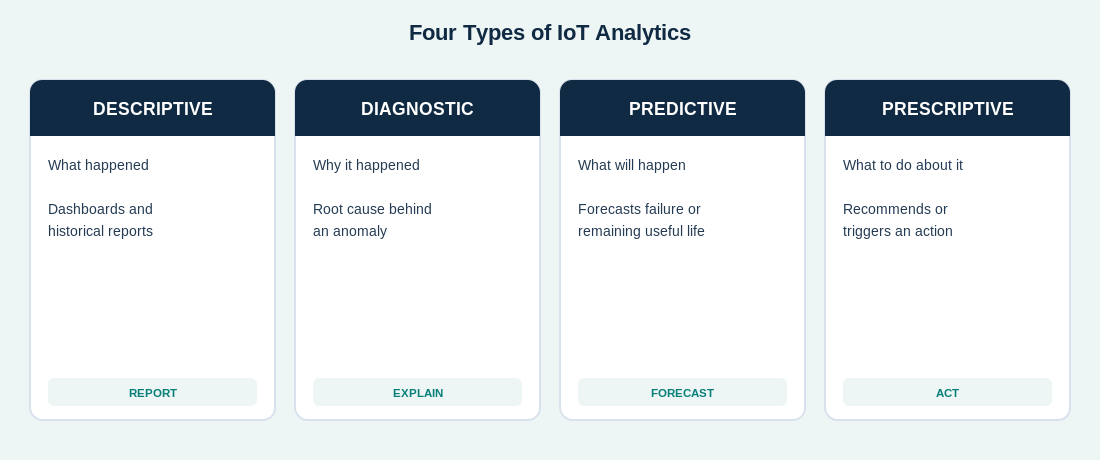
The analytics layer sits above the data management layer and applies statistical methods, rules and machine learning models to turn stored readings into insight. Enterprise IoT deployments typically work through four types of analysis, moving from simple reporting towards automated decision-making (Knowi, 2026):
- Descriptive: what happened. Dashboards, reports and summaries of historical readings.
- Diagnostic: why it happened. Drilling into descriptive data to find the cause of an anomaly or a failure.
- Predictive: what will happen. Statistical models and machine learning forecast future states, such as when a component is likely to fail.
- Prescriptive: what to do about it. Recommending, or in more mature systems automatically triggering, a specific action based on the prediction.
Most real deployments need all four working together, not just the most advanced one. A prescriptive system with no descriptive layer underneath it is very hard to trust or debug when it gets something wrong.
Predictive maintenance: the use case that pays for itself
Predictive maintenance is the clearest example of IoT analytics justifying its own cost, and it remains the dominant application driving the sector: the global IoT analytics market is projected to grow from roughly $35.4 billion in 2026 to $136 billion by 2033 (Tractian, 2026).
The mechanism is straightforward even where the models are not: machine learning models trained on historical and real-time sensor data forecast equipment degradation and estimate a component’s remaining useful life, flagging a likely failure before it happens rather than relying on a fixed maintenance schedule or waiting for a breakdown (ifactoryapp, 2026). Organisations running predictive maintenance analytics report reductions of up to 50% in unplanned downtime and around 25% in maintenance costs compared with reactive or fixed-schedule approaches (Tractian, 2026).
Making analytics usable: dashboards people actually act on
Analytics only creates value once it reaches someone who can act on it, in a form they can actually use. Role-specific dashboards, where a maintenance technician, an engineer and a manager each see the view relevant to their job rather than one generic report, are consistently what separates an analytics platform that gets used from one that gets ignored after the first month (Tractian, 2026).
This is also where the wider shift in decision-making shows up: Gartner has estimated that by 2026, 65% of B2B sales and operations organisations will have moved from intuition-based to data-driven decision-making. That shift only happens if the analytics layer produces something a non-specialist can trust and act on quickly, not just a model that is statistically correct.
What to check before you commit
- Which of the four analytics types you actually need first. Predictive and prescriptive analytics are only as good as the descriptive and diagnostic layers underneath them; do not skip straight to the most advanced tier.
- Who the output is for, and whether they can act on it. A dashboard nobody checks or a model nobody trusts delivers no value regardless of its accuracy.
- Data quality feeding the model. Predictions are only as reliable as the governed, cleaned data described in the data management layer; garbage in still means garbage out.
- What “good enough” accuracy looks like for the decision being made. A predictive maintenance model does not need to be perfect, only better than the fixed schedule or reactive approach it is replacing.
- The path from insight to action. Confirm whether the system recommends an action for a person to approve, or triggers it automatically, and that the right safeguards exist for the latter.
Related reading
- Data Management Layer: storage, governance and making IoT data usable
- Edge Computing Layer: what to process locally and what to send to the cloud
About this page
Written by Mark Searle, founder of IoT Heart and an IoT connectivity professional with more than 20 years’ experience across network engineering, solution architecture and commercial connected services. This page is based on publicly available industry data and reporting, current as of August 2026; market figures and vendor capabilities move quickly, so check current sources before a platform decision.
Want the practical version of updates like this delivered twice a month? Join the IoT Heart Briefing.
Sources