
Everything below this layer, sensors, connectivity, edge processing, storage and analytics, exists to support one moment: a person or a system looking at something and acting on it. The application layer is where an IoT deployment either proves its value or quietly gets ignored, and which of those happens usually comes down to interface design and integration, not the sophistication of the analytics underneath it.
What the application layer actually does
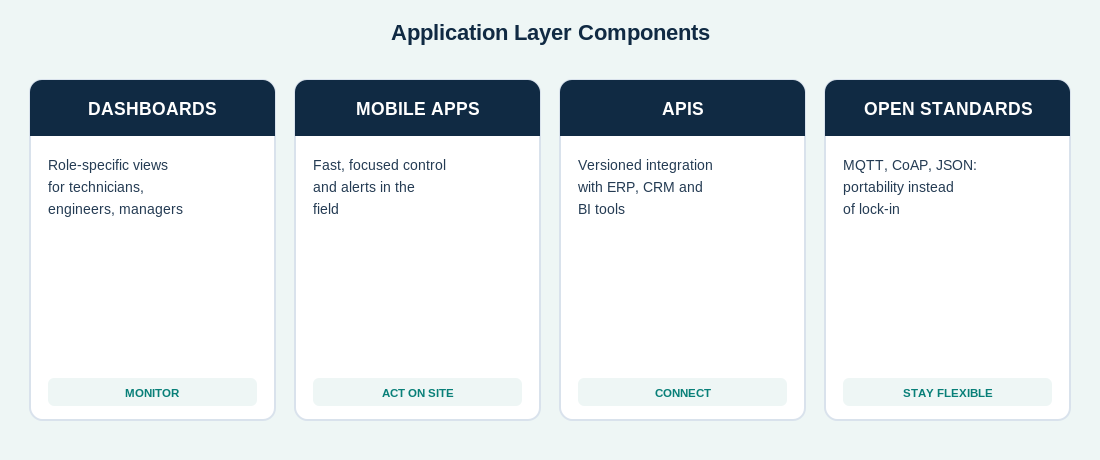
The application layer is the set of dashboards, mobile apps, web portals and APIs that let people and other systems access and act on what an IoT deployment has learned. It includes the interfaces that let end users control and monitor devices directly, and the integration layer of APIs that lets the platform plug into the rest of the business: enterprise resource planning, customer relationship management, business intelligence tools and custom internal systems (TechAhead, 2026).
These interfaces determine whether an IoT investment delivers operational value or simply generates data that nobody acts on (TechAhead, 2026). A technically excellent analytics layer feeding a dashboard nobody opens has delivered nothing.
Dashboards and mobile apps: built for the person using them
The interface has to match the person and the moment they are using it in. A maintenance technician standing next to a machine needs a fast, focused mobile view; a manager reviewing fleet-wide performance needs a different dashboard entirely. Modern IoT applications increasingly combine real-time dashboards, alerting and automated workflow triggers into one system rather than separate tools (TechAhead, 2026).
AI features have moved from differentiator to expectation in this layer: anomaly detection, predictive maintenance alerts and natural-language summaries of what changed are increasingly treated as table stakes for a 2026-era IoT application rather than an advanced add-on (TechAhead, 2026).
Integration: connecting to the rest of the business
An IoT deployment that cannot talk to the systems the business already runs on stays a standalone tool rather than becoming part of how the business operates. A well-documented, versioned API layer, whether REST, GraphQL or webhook-based, lets the platform plug into existing ERP, CRM and business intelligence tools without the integration itself becoming a dependency on a single vendor (Kong, 2026).
Avoiding vendor lock-in
Vendor lock-in happens when switching platforms becomes prohibitively expensive or disruptive, whether through proprietary APIs, non-portable data formats, or integrations that only work inside one vendor’s ecosystem (Kong, 2026). Open standards are the practical defence: standardised data formats and messaging protocols such as MQTT, CoAP and HTTP let devices and applications from different vendors communicate reliably, and keep migration a realistic option rather than a theoretical one (Kong, 2026).
What to check before you commit
- Who actually uses each interface, and what they need in the moment they use it. Design the dashboard or app around the user’s task, not around the data that happens to be available.
- Whether the platform uses open standards and data formats, or proprietary ones that would make switching platforms later difficult or costly.
- API documentation and versioning, since this is what determines whether integrating with the rest of the business is straightforward or a recurring engineering cost.
- What happens to historical data and configuration if you switch platforms. Confirm export options exist before you need them, not after.
- Whether AI-driven features (anomaly detection, predictive alerts) are genuinely useful for your use case, or added because competitors have them.
Related reading
- Analytics Layer: turning IoT data into decisions
- Data Management Layer: storage, governance and making IoT data usable
About this page
Written by Mark Searle, founder of IoT Heart and an IoT connectivity professional with more than 20 years’ experience across network engineering, solution architecture and commercial connected services. This page is based on publicly available industry data and reporting, current as of August 2026; platform capabilities and vendor offerings move quickly, so check current sources before a platform decision.
Want the practical version of updates like this delivered twice a month? Join the IoT Heart Briefing.
Sources