
Most IoT projects do not fail because they collect too little data. They fail because nobody decided what should happen to the data once it arrives: where it is stored, for how long, at what resolution, and who is accountable for its accuracy. The data management layer is where those decisions live, and getting them wrong is expensive to fix retroactively once billions of readings are already sitting in the wrong place.
What the data management layer actually does
Every device layer and connectivity choice eventually produces a stream of timestamped readings that has to be ingested, stored, organised and made available to the analytics and application layers above it. The data management layer is the combination of ingestion pipeline, storage architecture and governance policy that keeps that stream usable as it grows from a pilot’s thousands of readings to a production fleet’s billions.
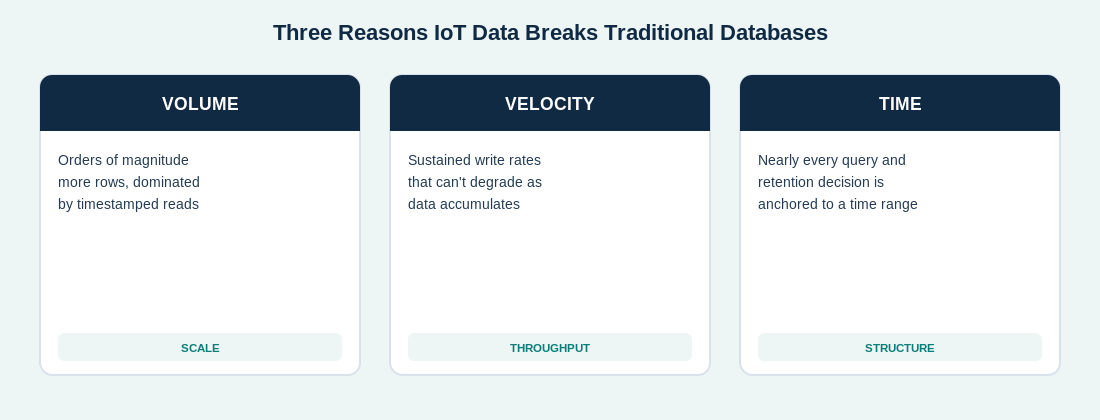
The core difficulty is that IoT data does not behave like the data most conventional databases were built for. It breaks the assumptions of traditional databases in three specific ways: the volume is orders of magnitude larger and dominated by time-stamped measurements, the velocity of sustained write throughput cannot degrade as data accumulates, and nearly every query and retention decision is anchored to a time range rather than a specific record (Tiger Data, 2026).
Storage: why IoT data needs a purpose-built approach
A modern IoT data architecture typically combines streaming ingestion, dedicated time-series storage, and a clear separation between operational data (what is needed right now) and historical analytics data (what is kept for trend analysis and compliance). Time-series workloads specifically need time-ordered storage, append-optimised ingestion, automatic rollups for older data, and lifecycle management that ages data out to cheaper storage tiers automatically rather than as a manual task (Tiger Data, 2026).
Purpose-built time-series databases exist specifically to handle this pattern at scale; some can sustain millions of inserted points per second while still returning fast queries over historical ranges, using storage layouts designed to convert the constant stream of small writes into efficient sequential operations rather than the random writes that slow conventional databases down under this kind of load (Apache IoTDB documentation).
Governance: retention, quality and the AI-readiness link
Governance has become the harder problem. Most organisations are not struggling to collect IoT data in 2026; they are struggling to control what they have already collected (Dataversity, 2026). A working governance policy needs to cover, at minimum:
- Retention and lifecycle. How long each category of data is kept at full resolution, when it is aggregated or downsampled, and when it is archived or deleted.
- Data quality. Sensor malfunctions, network drops and clock drift all produce inaccurate or incomplete readings; a governance policy needs a way to flag or exclude this data before it reaches a dashboard or a model, not after.
- Classification and lineage. Knowing what a given data field means, where it came from and what has been done to it is a prerequisite for trusting any analysis built on top of it.
This is not an abstract compliance exercise. Through 2026, a widely cited estimate suggests organisations will abandon roughly 60% of AI projects that are not supported by properly governed, AI-ready data; classification, lineage and governed retention are exactly the groundwork that AI-ready data requires (Archon Data Store, 2026).
What to check before you commit
- Storage architecture matched to the query pattern. Confirm whether you need fast recent-data queries, long-range historical analysis, or both, before choosing a database.
- A retention and downsampling policy defined from day one, not retrofitted once storage costs become a problem.
- A data quality process that flags sensor faults, gaps and clock drift before that data reaches a dashboard, report or model.
- Data lineage and classification, particularly if any of the data will eventually feed a machine learning model or a compliance report.
- Cost at your actual data volume, since storage and query costs for time-series data scale differently to conventional application databases.
Related reading
- Understanding the Device Layer: sensors, actuators, embedded compute and hardware security
- Edge Computing Layer: what to process locally and what to send to the cloud
About this page
Written by Mark Searle, founder of IoT Heart and an IoT connectivity professional with more than 20 years’ experience across network engineering, solution architecture and commercial connected services. This page is based on publicly available industry data and technical documentation, current as of August 2026; data platform capabilities and pricing move quickly, so figures should be checked against current sources before an architecture decision.
Want the practical version of updates like this delivered twice a month? Join the IoT Heart Briefing.
Sources
- Tiger Data – Why IoT Data Breaks Traditional Databases (and What to Do Instead)
- Tiger Data – The Best Databases for IoT in 2026: A Practical Comparison
- Apache IoTDB – A Time Series Database for Large Scale IoT Applications
- Dataversity – IoT Data Governance: Taming the Deluge in Connected Environments
- Archon Data Store – Information Lifecycle Management Explained: Guide for 2026