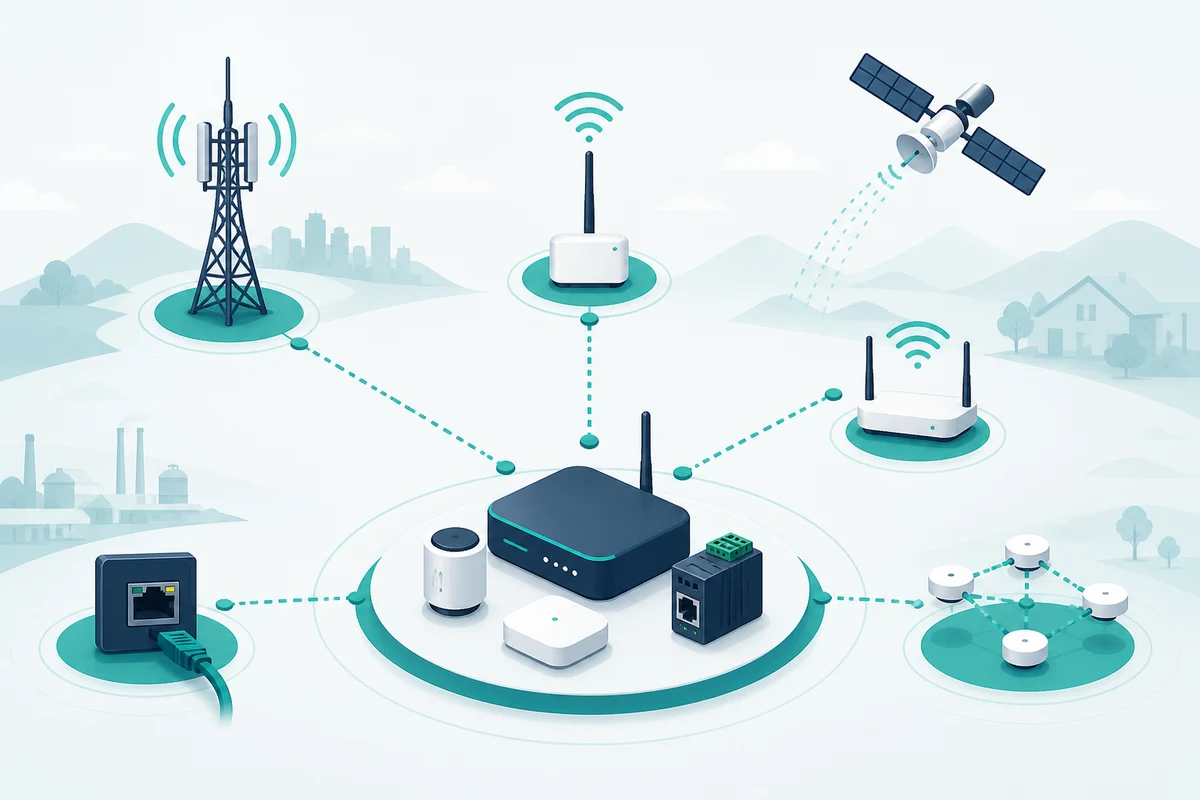

eSIM gets talked about as though it is one thing. In practice it is a family of standards that solve different problems: consumer phone switching, industrial fleet provisioning and, increasingly, chip-level integration for constrained devices. If you are specifying connectivity for a connected product, the standard you actually need depends on what you are building and how you plan to manage it once it is in the field.
What eSIM actually is
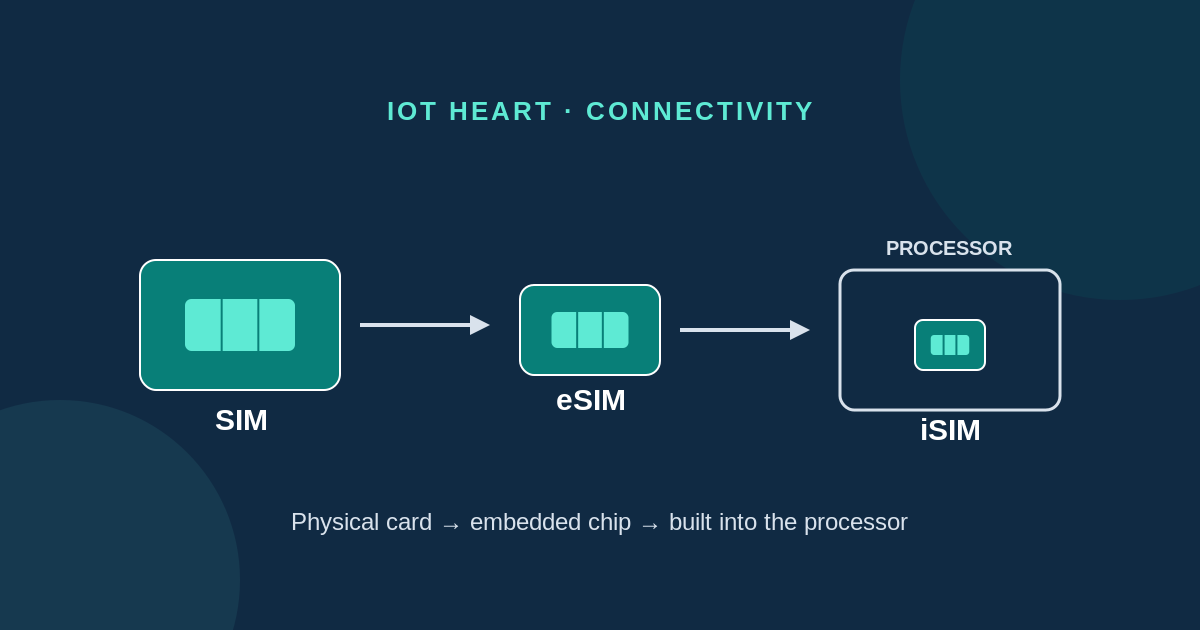
An eSIM (embedded SIM) is a SIM function built into a chip that is soldered onto a device’s circuit board rather than inserted as a removable card. The device still authenticates to a mobile network exactly as a physical SIM would; what changes is that the network profile, the data that ties the device to a specific operator, can be provisioned and changed remotely rather than by swapping a card.
This distinction matters for IoT in a way it doesn’t for phones. A consumer can walk into a shop and swap a SIM. A sensor bolted to a wind turbine, a shipping container mid-ocean, or a meter inside a locked utility cabinet cannot. Remote provisioning is not a convenience feature for IoT; it is often the only practical way to manage connectivity over a device’s operating life.
Why it matters more for IoT than for phones
Three IoT-specific pressures make eSIM (and its provisioning standards) more or less a requirement, not a nice-to-have:
- Device lifecycles routinely outlast operator contracts. A smart meter or industrial sensor might run for ten to fifteen years; a connectivity contract rarely does. Being able to switch operator profile remotely avoids a fleet-wide truck roll when a contract ends.
- Physical access is often impossible or prohibitively expensive. Devices get embedded in concrete, buried, submerged or shipped to locations without local support.
- Global products need local connectivity everywhere they’re sold, without shipping market-specific hardware variants.
The standards that actually matter
The GSMA (the mobile industry’s standards body) has published several eSIM specifications, and the differences between them are the source of most of the confusion in this space.
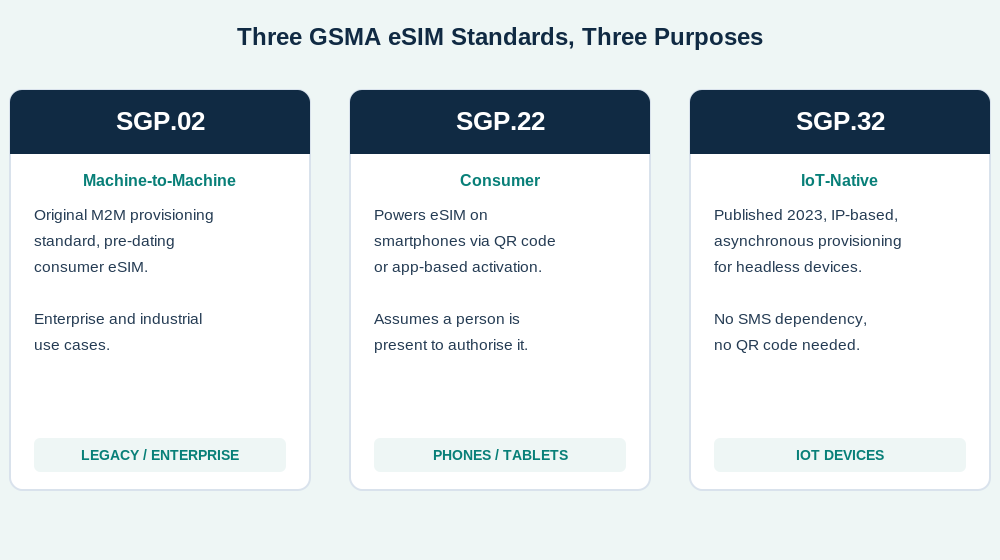
SGP.02 is the original machine-to-machine (M2M) provisioning standard, designed for industrial and enterprise use before “eSIM” was a consumer term.
SGP.22 is the consumer standard: the one behind eSIM on smartphones, using a QR code or app-based flow that assumes a person is present to authorise the switch. It was never designed for headless devices.
SGP.32, published by the GSMA in May 2023 and reaching version 1.2 in late 2024, is the standard built specifically for IoT. It enables IP-based, low-power, asynchronous profile provisioning across NB-IoT, LTE-M and LPWAN, without SMS dependency or the vendor lock-in of earlier M2M approaches, and without requiring a person to scan a QR code (Onomondo, 2026). Certified products began appearing in 2025, but ecosystem maturation has pushed most commercial acceleration to the second half of 2026 (euicc.co.uk, 2026). Forecasts vary by analyst: ABI Research projects SGP.32 profile downloads growing from 2.9 million in 2025 to 194 million by 2029, while Kaleido Intelligence forecasts around 50 million SGP.32-compliant eSIMs under management globally by 2027.
If you are specifying a new IoT product today, SGP.32 is the standard to design around for headless, remotely-manageable connectivity. Confirm your module vendor and connectivity provider both support it before committing, since real-world support is still catching up to the specification.
iSIM: the next step down in size and power
iSIM (integrated SIM) takes the same idea further by building the SIM function directly into the device’s main processor rather than a separate chip. This removes a discrete component entirely, which matters for the smallest, most power-constrained devices: smart meters, asset trackers and other designs where every square millimetre and milliwatt counts.
Adoption is accelerating from a low base. One estimate puts iSIM connections growing roughly 1,200% from around 800,000 in 2024 to an estimated 10 million in 2026, with the wider market forecast to reach 300 million by 2027. Around 64% of connectivity suppliers surveyed said they were considering adopting iSIM as part of their IoT offering (IoT Business News, March 2026).
Good fit for: ultra-low-power, small-form-factor devices where board space and power budget are the binding constraints, and where you’re designing for volume manufacture at scale.
What to check before committing to eSIM for a product
- Which standard your module and connectivity provider actually support. “eSIM” alone doesn’t tell you whether you get consumer-style (SGP.22) or IoT-native (SGP.32) provisioning; ask directly.
- How many profiles you need, and whether switching is actually remote. Most IoT eSIM implementations support somewhere between five and 24 stored profiles, with only one active at a time; check this matches your multi-market or multi-operator plans.
- What happens at end of contract with your current connectivity provider. Confirm you retain the practical ability to switch, not just the theoretical standards support.
- Regulatory and security requirements in your target markets, since remote provisioning has its own compliance considerations separate from the radio technology itself.
- Total cost, including any platform or management fees on top of airtime; remote provisioning capability is not free to operate at fleet scale.
What eSIM doesn’t solve
eSIM changes how a device’s network identity is managed. It doesn’t change coverage, doesn’t reduce power consumption on its own, and doesn’t replace the need to choose the right underlying connectivity technology in the first place. See The IoT Connectivity Layer for how eSIM fits alongside cellular, LPWAN, Wi-Fi and satellite choices.
Related reading
About this article
Written by Mark Searle, founder of IoT Heart and an IoT connectivity professional with more than 20 years’ experience across network engineering, solution architecture and commercial connected services. This article is based on GSMA published specifications and current industry reporting, current as of August 2026; standards adoption and vendor support move quickly, so verify current support with your module vendor and connectivity provider before committing a design.
Want practical connectivity and eSIM updates twice a month? Join the IoT Heart Briefing.
Sources
- Onomondo – What is GSMA SGP.32? Diving into the eSIM IoT standard
- euicc.co.uk – What Is SGP.32? The Definitive Guide to IoT eSIM Provisioning
- IoT Business News – eSIM and iSIM for IoT: Remote Provisioning, Flexibility and Scale
- GSMA – SGP.32 v1.3
Discover more from IoT Heart
Subscribe to get the latest posts sent to your email.