
IoT connects physical devices to software and services so they can collect data, respond to commands and support useful automation. Everyday examples include smart thermostats, connected lighting and security sensors, but the same principles also underpin industrial monitoring, logistics and connected products.
If you are new to IoT, start with the problem you want to solve rather than the gadget. Understand what happens if the internet connection fails, check compatibility with the platform you already use, and confirm how long a supplier provides security updates before you commit to any device. Books are a cheaper, lower-risk way to build that judgement before you spend money on hardware.
How this guide was put together. These are desk-research recommendations, not first-person reviews: we have not read each book cover to cover. The picks below are based on publisher information, professional reviews and reader ratings, and each is chosen for a different starting point rather than ranked against the others. If you want a specific technical question answered before buying, check the book’s table of contents on the publisher’s site first.
Affiliate disclosure: this article may contain Amazon affiliate links. IoT Heart may receive a commission if you buy through them, at no extra cost to you. Editorial conclusions are not determined by affiliate relationships.
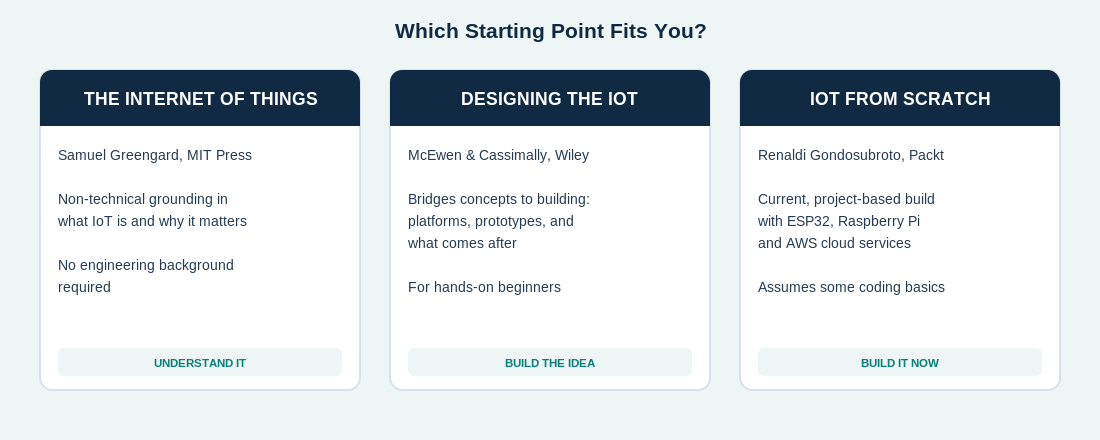
For understanding what IoT actually is: “The Internet of Things” by Samuel Greengard
Part of MIT Press’s Essential Knowledge series, this is a short, non-technical primer aimed at readers who want to understand the concept and its implications before touching any hardware or code. It covers how IoT works, how it developed, and where it is heading, without assuming an engineering background.
Good fit for: managers, product owners and generally curious readers who need to understand IoT well enough to make decisions about it, not build it themselves.
For a practical bridge from concept to build: “Designing the Internet of Things” by Adrian McEwen and Hakim Cassimally
Published by Wiley, this book walks from IoT fundamentals through to genuinely practical territory: internet protocols, APIs, and a comparison of platforms including Arduino, Raspberry Pi and BeagleBoard. A second half covers what happens after a working prototype, including business modelling, funding and moving from a single unit to small-batch manufacture.
Good fit for: readers who want to understand the concepts and then actually build something, including the practical questions that come after a prototype works.
For a current, hands-on build guide: “Internet of Things from Scratch” by Renaldi Gondosubroto
Published by Packt in 2024, this is the most current and most hands-on of the three. It works through building IoT solutions with ESP32 and Raspberry Pi hardware and AWS cloud services, aimed at Industry 4.0-style use cases, and assumes some foundational programming knowledge and familiarity with microcontrollers rather than starting from zero.
Good fit for: readers with some technical background who want a current, project-based guide to building and connecting real hardware, including the cloud side.
What to check before you buy any IoT book
- Match the book to what you actually need. A conceptual overview and a hands-on build guide serve different purposes; buying the wrong one for your goal is the most common mistake.
- Check the publication date against the hardware it covers. IoT hardware and cloud platforms move fast; a book built around a specific board or service can date quickly.
- Look at the publisher, not just the star rating. Established technical publishers (O’Reilly, Wiley, Packt, MIT Press and similar) generally have an editorial and technical review process that self-published titles do not.
- Read the table of contents before the reviews. It tells you faster than a review whether the depth matches what you need.
Related reading
- Understanding the Device Layer: sensors, actuators, embedded compute and hardware security
- IoT Device Layer Explained: Sensors, Actuators and Design Choices
About this article
Written by Mark Searle, founder of IoT Heart and an IoT connectivity professional with more than 20 years’ experience across network engineering, solution architecture and commercial connected services. This article is based on publisher information and publicly available reviews, current as of August 2026; check current pricing and edition details before buying.
Want the practical version of updates like this delivered twice a month? Join the IoT Heart Briefing.
Sources
- MIT Press – The Internet of Things, by Samuel Greengard
- Wiley – Designing the Internet of Things, by Adrian McEwen and Hakim Cassimally
- Packt – Internet of Things from Scratch, by Renaldi Gondosubroto
Discover more from IoT Heart
Subscribe to get the latest posts sent to your email.